

The lowest-cost billing setup isn’t always the one with the fewest visible expenses. Outsourced medical billing services shift coding and billing work to an external team, commonly covering claim submission, denial management, and payment posting. This changes not only who processes claims, but also how a practice accounts for staffing, training, systems, and oversight.
Billing teams handle detailed payer workflows, so the choice between outsourcing and in-house operations affects both daily workload and revenue cycle oversight. This comparison explains what outsourced billing can include, how to weigh its costs against the full expense of an in-house team, and what to assess in a provider’s security practices and HIPAA compliance. Factors such as service scope, claim volume, staffing needs, and performance reporting all shape the decision. The goal is to determine which model fits your practice and how to evaluate coverage while protecting patient data.
Key Takeaways
- Map the billing tasks your practice needs covered before comparing in-house and outsourced models.
- Assess total operating costs, including less visible staffing and oversight requirements, rather than focusing on one expense.
- Evaluate how a billing partner protects patient information and supports HIPAA compliance.
- Use service scope and reporting needs to identify the model that best fits your practice’s revenue cycle.
What Is Outsourced Medical Billing?
Outsourced medical billing services assign billing and claims processing to an external team rather than practice employees. The work can include claim filing and submission, denial follow-up, and payment posting, with the exact scope shaped by the practice’s workflow.
Claim Submission and Payment Posting
This work covers claims from preparation through recorded payment. The billing team reviews claim information, submits it to the payer, and posts payments after remittance. Unlike denial management, it focuses on routine processing and account updates. Accurate posting helps practices see what insurers paid, what remains outstanding, and where follow-up may be needed.
Claim Accuracy and Denial Management
Accuracy review aims to prevent errors before claims reach payers; denial management addresses claims returned unpaid or rejected. Common causes include inaccurate coding, missing documentation, and late submissions. A billing team can review rejected claims, identify the issue, correct claim details, and submit or appeal them as appropriate. Unlike payment posting, this work investigates exceptions rather than recording completed payments.
Transitioning Billing to an Outsourcing Provider
A transition typically begins by defining the work in scope and documenting current workflows, payer requirements, and outstanding accounts. The practice and billing team then coordinate access, transfer relevant billing information, and establish communication and reporting procedures. Training supports consistent handoffs, while staged workflow changes help maintain claim continuity. These steps are distinct from ongoing claims processing, which manages daily submissions and account activity.
Specialty and Practice-Size Tailoring
Services are tailored to the practice’s coding review, payer workflows, claim volume, and follow-up needs. Specialty affects coding requirements and documentation patterns; practice size influences workload distribution and staffing structure. A small practice may need focused support for selected billing tasks, while a larger group may need broader claims coverage. Tailoring lets the scope reflect operational needs instead of imposing a fixed workflow.
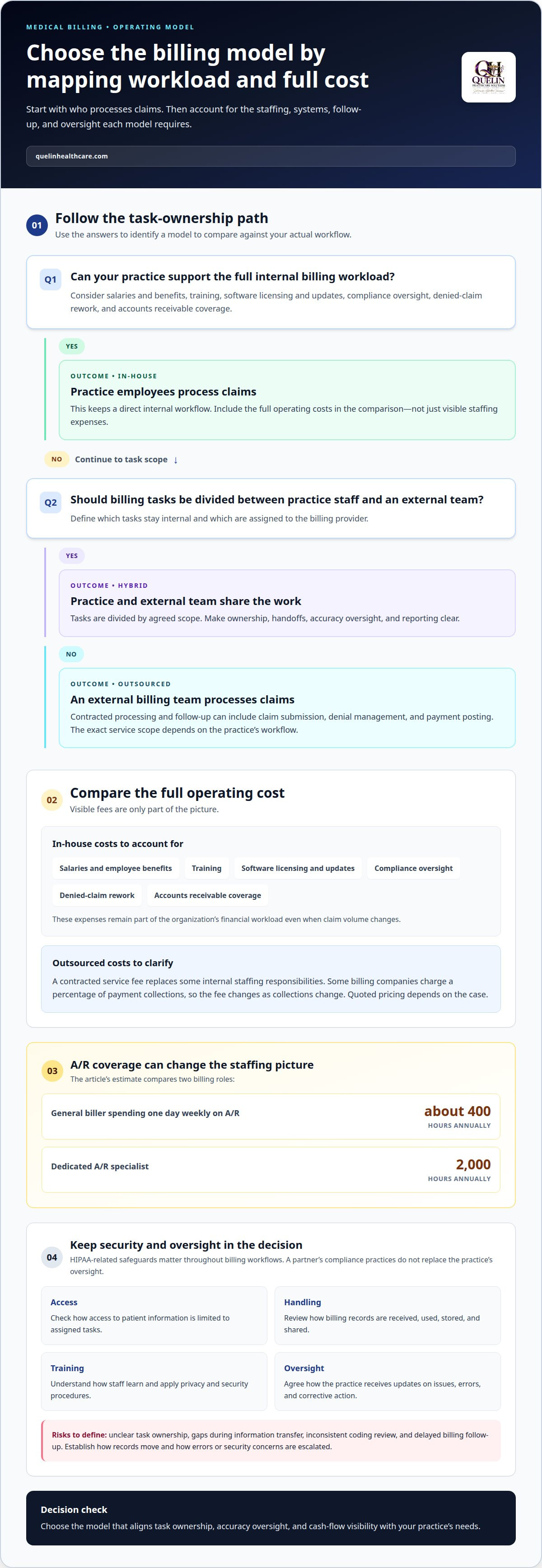
| Option | Who processes claims | Primary distinction |
|---|---|---|
| In-house | Practice employees | Direct internal workflow |
| Outsourced | External billing team | Contracted processing and follow-up |
| Hybrid | Practice and external team | Tasks divided by agreed scope |
Choose the model that aligns task ownership, accuracy oversight, and cash flow visibility with your practice’s needs.
Patient data security and HIPAA compliance
Billing workflows use patient information to prepare claims, review coding, and track revenue. Under HIPAA, security matters at every step, including how access is managed, records are handled, and information is shared. A billing partner’s compliance practices should be supported by clear protocols and do not replace the practice’s oversight.
Evaluate a medical billing company by reviewing its security procedures, staff training, access controls, coding expertise, and reporting practices. Confirm that its processes address patient privacy and that responsibilities for administrative work are clearly defined. The Office of Inspector General issued compliance guidance for third-party billing companies in 1998, underscoring that billing operations involve compliance considerations as well as claims processing.
- Access: Identify how the company limits staff access to patient information needed for assigned tasks.
- Handling: Review procedures for receiving, using, storing, and sharing billing records.
- Training: Understand how staff learn privacy and security procedures and apply them during daily work.
- Oversight: Establish how the practice receives updates about process issues, errors, and corrective action.
These criteria help you compare documented security practices with the sensitivity of the data and the scope of the work. Specialty knowledge matters too: accurate coding and documentation review can support compliance and reduce avoidable denials, while consistent administrative workflows help protect revenue cycle processes.
Common outsourcing risks include unclear task ownership, gaps during information transfer, inconsistent coding review, and delayed billing follow-up. Define who handles each workflow, how records move between teams, and how errors or security concerns are escalated. Clear procedures make potential problems visible instead of leaving them buried in routine claims activity.
For practices strengthening billing oversight, revenue cycle management support can connect administrative processes with coding and auditing review.
Comparing outsourcing costs with in-house billing
Compare the full operating cost of each model, not just visible staffing expenses. The comparison should account for the work covered, its accuracy, and the resources needed to manage submitted claims and reimbursements.
In-House Billing Costs and Overhead
In-house costs include salaries, employee benefits, training, software licensing and updates, compliance oversight, and time spent reworking denied claims. These expenses remain part of the organization’s financial workload even when claim volume changes. Accounts receivable coverage also matters: one estimate puts a general biller spending one day weekly on A/R at about 400 hours annually, compared with 2,000 hours for a dedicated A/R specialist.
Outsourced Billing Costs and Pricing Models
Outsourcing replaces some internal staffing responsibilities with a contracted service fee. Some billing companies charge a percentage of payment collections, so the fee changes as collections change. The quoted price depends on the case and is given after a quote request; scope, specialty, claim volume, and workflow needs shape the cost. Compare the fee with the specific billing tasks and oversight included.
Variable Costs and Hidden Fees
Outsourcing can also involve setup charges, membership fees, legal fees, or infrastructure upgrades. These differ from recurring service charges because they may arise during setup or when systems need adjustment. In-house operations have variable costs too: additional training, software updates, and claim rework can increase workload beyond regular salaries. Include these categories in the same comparison.
Build a side-by-side estimate by listing each cost once and assigning it to the model responsible for that work. For example, count internal training and benefits under in-house operations, and setup or infrastructure expenses under outsourcing. Compare both totals against the required coverage and expected workflow. Efficiency and accuracy matter: low operating costs have limited value if accounts remain unresolved or claims need repeated correction.
Services included in outsourced billing
Outsourced billing can cover more than claim submission. A practice can assign defined revenue cycle tasks to an external team while keeping other steps in-house. Compare the work included, the handoffs involved, and the information returned to staff.
Common service components include administrative work before and after a claim reaches an insurer. Depending on the agreed scope, an outsourced team may handle:
- Eligibility review and prior authorization workflows before a visit.
- Medical coding review to identify claim details that need correction.
- Claim filing, submission, and follow-up with insurance payers.
- Denial review, accounts receivable follow-up, and appeal preparation.
- Payment posting and responses to patient payment inquiries.
These tasks connect across the revenue cycle. Eligibility information can affect claim preparation, while coding review can flag errors before submission. After a payer responds, payment posting records the transaction, and follow-up addresses any remaining balance or denial. Defining these handoffs shows where internal staff remain responsible.
Some outsourced teams also provide access to billing platforms, coding specialists, and analytics. Reporting can track days in accounts receivable, denial rates, and patient payment patterns. These measures help administrators identify workflow bottlenecks, such as recurring denials or slow payer follow-up. Any platform access and reporting should fit the practice’s existing processes and assigned tasks.
The scope can be narrow or broad. A practice might outsource coding review and denial follow-up while keeping patient communications in-house. Another may assign claim processing, payment posting, and accounts receivable work together. The key is to identify which tasks create the greatest administrative burden and need consistent specialist attention. A written division of responsibilities clarifies coverage and reduces handoff confusion.
To align billing coverage with your workflow, discuss your medical billing needs.
Quelin Healthcare Solutions: Medical Billing and Revenue Cycle Management
Quelin Healthcare Solutions supports practices that need structured billing oversight, coding review, or better coordination across revenue cycle tasks. Its Medical Billing and Revenue Cycle Management service supports billing workflows, while Medical Coding and Auditing helps with claim accuracy and documentation review.
Practices can also use Eligibility and Prior Authorization for coverage steps before services, or Credentialing and Payer Enrollment to manage payer participation. These services can help when internal teams face workload pressure, recurring claim issues, or gaps between administrative steps. The right support depends on which processes need attention and how responsibilities should be organized.
If you’re assessing outsourced billing, a conversation can clarify the workflows involved and the operational support that fits. Contact Quelin Healthcare Solutions to discuss your practice’s billing needs.
Set a Clear Path for Your Billing Workflow
Turn your billing model decision into a practical operating plan. Identify which responsibilities should stay with practice staff, which could be assigned externally, and how each handoff will work. A clear scope gives your team a shared reference for daily tasks, reporting, and escalation. It also keeps outsourced medical billing services aligned with your practice’s priorities rather than treating outsourcing as an all-or-nothing change.
Start by defining the workflow issue that needs attention, such as claim follow-up, coding review, or administrative capacity. Then clarify who owns each task and what information staff need to coordinate effectively. This approach keeps the next step focused on operational fit and makes a transition easier to assess.
Quelin Healthcare Solutions can discuss the billing needs and workflow priorities your practice wants to address. Contact Quelin Healthcare Solutions to start that conversation and determine a practical direction for your team.
Frequently Asked Questions
How are payments received and posted?
Payments are recorded by matching payer or patient remittance details to the corresponding account and claim. The billing workflow reconciles payments, adjustments, and outstanding balances against the practice’s records, then flags discrepancies for review. If an insurer pays only part of a claim, for example, posting identifies the remaining balance and routes it through the practice’s follow-up process.
How do you handle denied claims?
Denied claims are reviewed to identify the reason, supporting documentation, and appropriate next action. A missing record may require documentation follow-up, while a coding issue may need correction before resubmission. The billing team tracks the claim through its next step and records the outcome, helping the practice distinguish a resolved denial from an account that still needs attention.
How will this affect my patients?
Outsourcing changes the practice’s administrative workflow, so patient billing communication needs clear ownership. Before work begins, define who answers billing questions, handles statements, and routes concerns to practice staff. If a patient calls about a balance, for example, a documented handoff helps staff direct the inquiry without confusion. Clinical decisions and patient care remain with the practice.
Is Outsourcing Expensive?
Outsourcing is not inherently more or less expensive than in-house billing; the comparison depends on scope and total operating effort. Compare equivalent work over the same period, including staff time, training, software expenses, and administrative oversight alongside the contracted service. A narrower assignment may have a different cost profile from transferring a broader set of billing responsibilities.
What services are included in outsourced medical billing?
Included tasks depend on the agreed scope. A practice may assign claim preparation and follow-up, payment posting, denial work, accounts receivable support, or coding review. Some arrangements also cover eligibility and prior authorization. For a useful comparison, map each task to its owner and identify where information must pass between external billing staff and practice employees.
How much do outsourced medical billing services cost in the United States?
There is no single cost that applies to every U.S. practice. The price depends on the case and is provided after a quote request. Scope, specialty, claim volume, and workflow requirements affect the estimate. A practice evaluating outsourced medical billing services can define which tasks it needs covered and the expected handoffs, then use that scope to understand the proposed arrangement.